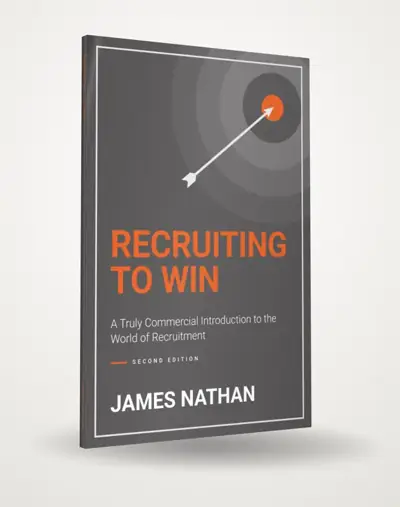
The book · Second edition

Recruiting to Win®

A Truly Commercial Introduction to the World of Recruitment

A plain-speaking, practical guide to real-world recruitment. Every chapter is rewritten for the way the job works today, with new material on AI, social selling, video, compliance and candidate experience, and a new chapter on recruiting with AI.

Buy on AmazonRead a sample

Paperback, hardback and Kindle

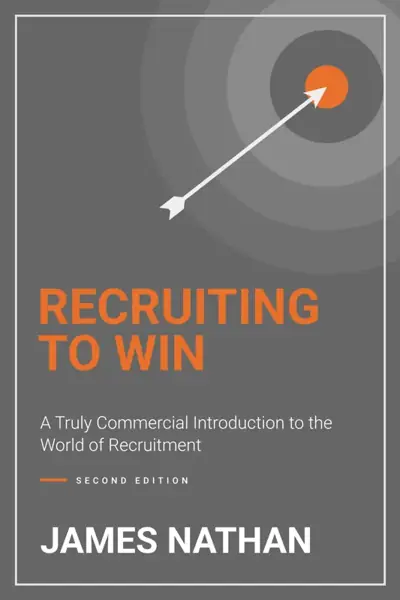
Recruiting to Win® second edition by James Nathan, book cover

What’s new in the second edition

Twelve years on from the first edition, a lot has changed. Yet recruitment is still a sales business, people still buy people, and the phone is still the most powerful tool on your desk. The tools have changed. The fundamentals haven’t.

A new chapter on recruiting with AI

What AI is good at and what it isn’t, how to use it safely and legally, and how to make it make you better, not replaceable.

Every chapter rewritten

For hybrid working, video interviews, LinkedIn and social selling, and today’s tools, from your CRM to the AI-written CV.

The rules you work within

The essentials, from the Employment Rights Act 2025 and data protection to umbrella company changes and AI in hiring decisions.

Candidate experience

Why the way you treat candidates is now a commercial advantage, and a simple standard to work to.

You will learn


Getting started the right way

How the industry works, where the money comes from and the rules you work within.


Finding and keeping great candidates

Sourcing, registration, interviewing, CVs and gaining exclusivity.


Business development that works

Why people buy, the phone (still) wins, and building your personal brand.


Winning and keeping clients

Getting meetings, rapport and control, and a simple pitch formula.


Filling jobs and closing offers

From the job brief to feedback, counter-offers and a safe first day.


Your time, and your tools

The perfect day, in the office or at home, and using AI without losing the human edge.

Samples from the book

Open a chapter to read an extract.

Introduction

Too many new consultants are still shown a desk (or a laptop and a login) and told to get on with it. Hybrid working has made that worse, not better. It is much harder to learn by osmosis when the best biller in the office is working from home on a Wednesday.

I want everyone coming into recruitment to get the best real-world training and advice available. The kind I received, and have tried to give to everyone I’ve trained since.

Recruitment is a sales business, plain and simple. Our job is to make a profit by placing people into new roles and helping our clients find the best people. Of course we help people along the way, and that matters enormously. But at its core, recruitment is commercial.

AI hasn’t changed that. If anything, it has made it more true. The parts of the job a machine can do are getting cheaper every month. The parts it can’t do (trust, judgement, influence, persuasion) are worth more than ever.

Chapter 3 · Candidate interviewing

Gaining exclusivity

Commercially, it’s very important to keep your best candidates exclusive to you, or at least to be their main recruiter. It stops competitors placing them, especially with your clients.

Trust and respect are everything

To gain exclusivity, the candidate needs to trust and respect you, and believe that you have their market covered. Get that right and they won’t feel the need to register anywhere else.

Early in the interview you’ll have asked who else they’re talking to. If the answer is nobody, or nobody yet, a simple “Are you happy to leave it with me for now?” usually does the trick.

If you’ve earned their trust, the answer is usually yes.

Chapter 5 · Introduction to business development

Business development is a vital part of what we do as recruiters. Unfortunately, it’s also the part many people have a mental block about. Plenty of others treat it as a chore. It really shouldn’t be that way.

Some people still call BD cold calling. But picking up the phone is only one part of it. Today, BD includes what you post on LinkedIn, the events you go to, the market insight you share, the way you follow up and the reputation your candidates give you. All of it adds up.

Why we buy anything

People buy things, especially expensive things, because they perceive value. Think about why someone would pay thousands of pounds for a Rolex when a Casio, or the phone in their pocket, would tell the time just as well.

The key to any sale is the buyer’s motivation to buy.

Chapter 6 · The phone (still) wins

In the first edition, I called this chapter “Telephone Techniques”. The techniques haven’t changed. What has changed is that the phone now sits alongside email, LinkedIn, WhatsApp and video. And it’s easier than ever to hide behind all of them.

Please don’t.

Phone versus everything else

So much of what should be done on the phone is now done by email, LinkedIn message or text. Those channels are great for some things. But you cannot build a relationship by typing.

It’s also much harder to ignore someone you’re speaking with. You can’t just delete them!

Chapter 11 · Recruiting with AI

This chapter didn’t exist in the first edition. In 2014, it would have been science fiction.

What AI is good at

Used well, AI can take a huge amount of low-value work off your desk: searching and matching, first drafts, research before a meeting, admin and spotting patterns in your numbers. The point isn’t the technology itself. It’s the time it gives back, and what the best recruiters do with it.

What AI isn’t good at

AI can’t build trust with a nervous candidate, read the hesitation in a hiring manager’s voice, persuade a passive candidate to take a call about a job they didn’t know they wanted, or talk someone through a counter-offer. It can’t take responsibility for a decision. And it can’t care.

Chapter by chapter

Chapter 1

The recruitment industry

  • How the industry is made up
  • Executive search, professional recruitment and generalist staffing
  • The forces reshaping it, including AI
  • The rules you work within

Chapter 2

Candidate management

  • The candidate cycle
  • Where candidates come from today
  • Registration
  • Candidate experience
  • Keeping in touch

Chapter 3

Candidate interviewing

  • Interview structure
  • Potential difficulties
  • Additional information needed
  • Gaining exclusivity

Chapter 4

The CV and the candidate profile

  • What makes a good CV
  • What employers and screening systems look for
  • The AI-written CV
  • The LinkedIn profile
  • CV dos and don’ts

Chapter 5

Introduction to business development

  • Why people buy
  • Features versus benefits
  • The BD process
  • Building your personal brand

Chapter 6

The phone (still) wins

  • Phone, email, LinkedIn and messaging
  • Introductory calling
  • Ad-chasing
  • Lead chasing

Chapter 7

Client relationship building and management

  • The client cycle
  • Getting client meetings
  • Preparing for and running a meeting
  • A simple sales and pitch formula

Chapter 8

Jobs

  • Taking a job brief
  • Gaining exclusivity
  • Writing great adverts
  • Selling jobs to candidates

Chapter 9

Managing the interview and offer process

  • Taking feedback
  • Offer management
  • Handling counter-offers
  • Getting your candidate safely to day one

Chapter 10

Time and portfolio management

  • Managing your time
  • The golden rules
  • The perfect day, in the office or at home

Chapter 11

Recruiting with AI

  • What AI is good at, and what it isn’t
  • Using it safely and legally
  • Keeping the trust of candidates and clients
  • Better, not replaceable

What recruitment people say

“James’s guidance has resulted in us winning more profitable business more often. A highly personable, commercially astute and passionate professional. I cannot recommend James highly enough.”

Max MacGillivray, MD, Redfox Executive Recruiters

“James is one of the most accomplished recruiters I have come across. He delivers and you’ll enjoy the experience too.”

Gary Watson, CEO, Investigo

“I recommend James on so many levels: insightful, intelligent, entertaining and relevant. His training was so enjoyable and really relevant to the tasks that I am doing. 10/10.”

Katie Davies, Consultant, HCL

“A great read, very accurate insight into today’s recruitment industry.”

Sarah Mayo-Evans, Owner, Peach Recruitment

“Relevant, informative and up to date.”

Lucy Hamilton, Consultant, Keystone Employment Group

Paperback, hardback or Kindle

Choose the format that suits you. All three are available from Amazon.

Recruiting to Win® second edition paperback

Paperback

Delivered to your door. Ideal for reading, marking up and keeping on the desk.

Buy on Amazon

Recruiting to Win® second edition hardback

Hardback

A lasting edition for your shelf, or a gift for someone starting out in recruitment.

Buy on Amazon

Recruiting to Win® second edition Kindle eBook

Kindle eBook

An instant download from the Kindle Store. Be reading in under a minute.

Buy on Amazon

James Nathan, recruitment trainer and author

About the author

James Nathan

James is a recruitment trainer, coach and author who has spent his whole career helping people in recruitment sell better, build stronger client relationships and grow their businesses.

He qualified as a Chartered Accountant before discovering recruitment, and spent nearly twelve years with a multinational recruitment group, building and running a network of regional and London offices and leading training across its finance and legal businesses. He then founded and led his own recruitment business.

Through Recruiting to Win® he has trained more than 200 recruitment agencies and in-house teams across the UK, Europe, the Middle East and North America.

“The best recruiters weren’t born with some special talent. They were trained, coached and mentored. And anyone can join them.”

More about James

Want this taught to your team?

The book covers the foundations. Recruiting to Win® training turns them into everyday habits on the desk, tailored to your market and your team.

Get in touch or book a 20‑minute call